
BIR Gothenburg 2026: The trends shaping the future of recycling
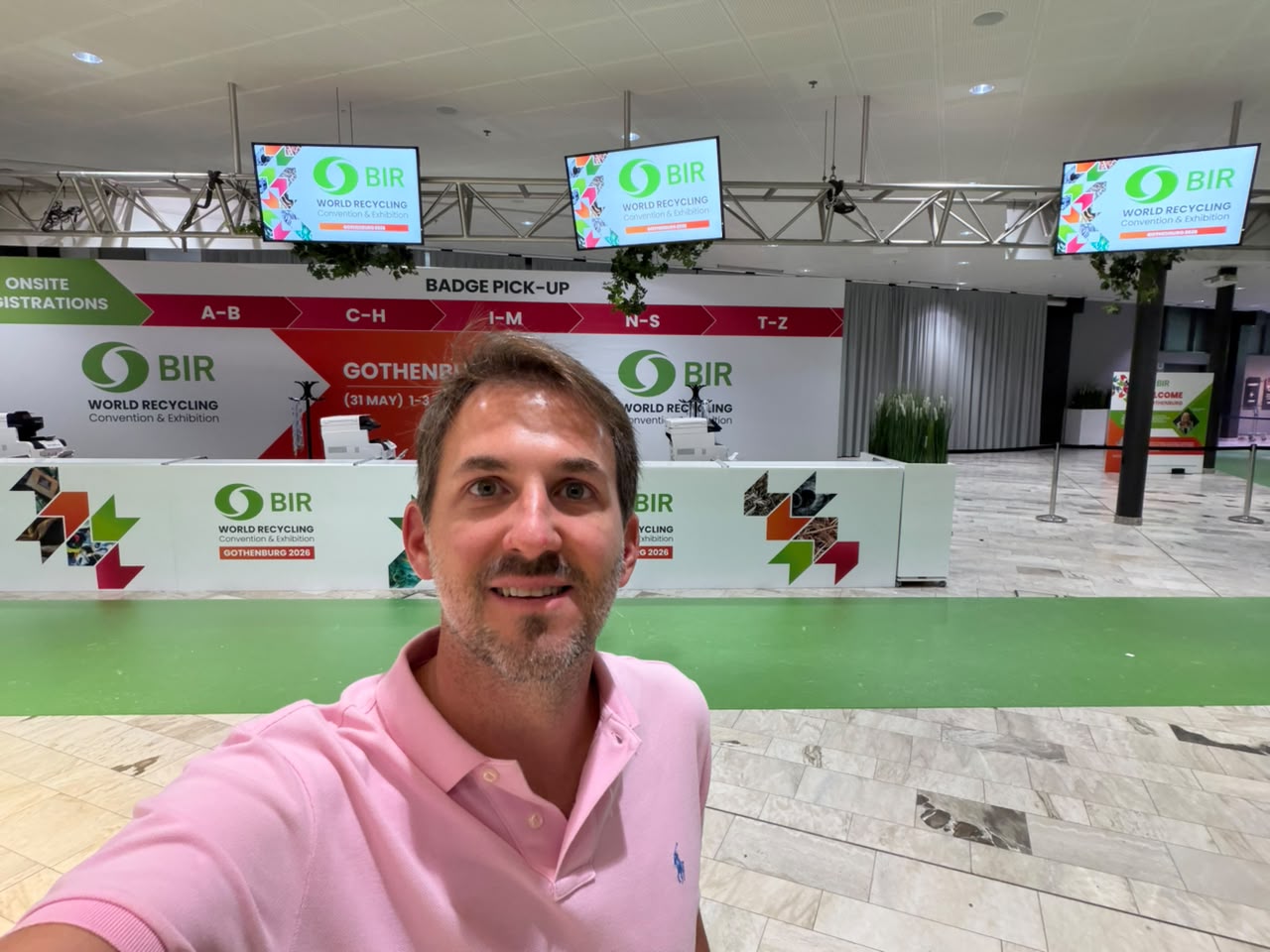
In June, we attended the BIR (Bureau of International Recycling) Convention held in Gothenburg, Sweden. This global recycling industry event brings together recyclers, industrial consumers, experts, associations, and industry leaders from around the world to discuss the challenges and opportunities shaping the future of the circular economy.
Representing Guarulhos Sucatas, our Director, Rafael Barros, participated in the event’s panels and discussions and returned with an even stronger conviction: recycling is becoming increasingly strategic for industry, the economy, and global supply chain security, in addition to its environmental importance.
Among the main topics discussed at BIR 2026 were artificial intelligence in recycling, recycled material quality, free trade of recycled raw materials, automotive recycling, critical minerals, and the strategic role of the circular economy for global industry.
Below, we share some of the key insights from the event.
Artificial Intelligence, Creativity, and Innovation
At Guarulhos Sucatas, we are already experiencing the advancement of Artificial Intelligence. Our Recovery Facility uses sorting equipment equipped with advanced technologies for the identification, classification, and recovery of recyclable materials.
Futurist Tom Cheesewright highlighted how artificial intelligence is expected to influence material quality, operational efficiency, recycled material management, and decision-making processes. Meanwhile, speaker Fredrik Härén offered a complementary perspective on creativity. According to him, creativity is about finding solutions to problems. It begins when we believe a solution is possible. No idea emerges from nothing. Every innovation results from combining existing knowledge and previous experiences.
This perspective has a direct connection to recycling itself. Just as we transform existing materials into something of greater value, innovation happens when we combine existing ideas in new ways to create better solutions.
The main conclusion was clear: future recyclers will not simply be suppliers of recycled raw materials. They will become strategic partners within industrial supply chains, offering quality, traceability, technical expertise, technological integration, and valuable solutions for supply chain resilience.
Free Markets and the Importance of Material Circulation
Another central topic was the impact of trade barriers on recycling. Recycled raw materials are global commodities, and their international flows have played a fundamental role in the industrial development of many countries.
Several experts presented examples showing that export restrictions tend to reduce material collection, lower economic value, and encourage the use of more carbon-intensive raw materials.
An important point emphasized during the discussions was that open markets and environmental regulation are not incompatible concepts. Both can coexist when public policies properly recognize the environmental and economic value of recycling.
The event also highlighted an ongoing shift in Europe’s perspective. Historically viewed merely as a recyclable material, ferrous scrap is increasingly being recognized as a strategic asset for industrial policy. The discussion now includes competitiveness, supply security, industrial autonomy, and reindustrialization.
Another valuable insight was understanding that European recyclers do not export simply because they prefer to. In most cases, exports occur because domestic demand is insufficient to absorb all available material. Local sales remain the simplest and most efficient option whenever a strong domestic market exists.
Additionally, available domestic technology is not always advanced enough to recycle certain specific materials. As a result, recyclers often need to seek more developed markets with the appropriate technologies. This reality is highly relevant for Brazilian recyclers as well.
Automotive Recycling Enters a New Phase
Discussions on automotive recycling demonstrated that the sector is undergoing a global transformation. Many countries are revising regulations and expanding manufacturers’ responsibilities throughout the vehicle life cycle.
The concept of Extended Producer Responsibility (EPR) continues to gain momentum, requiring automakers and manufacturers to share information about vehicle composition and play a more active role in developing circularity.
The harmonization of regulations across countries also emerged as a significant challenge. After all, a vehicle may be manufactured in one country, sold in another, and recycled in a third.
The discussions showed that end-of-life vehicles are no longer viewed simply as waste but increasingly as valuable sources of recycled raw materials. Among the major challenges are plastic recovery, advancements in chemical recycling technologies, and the impacts that pre-removal of components may have on shredding and material recovery processes.
The conclusion was that recyclers must actively participate in these discussions alongside automakers, regulators, industry associations, and other stakeholders.
Critical Minerals: A Challenge for the Coming Decades
The growing demand for electrification, renewable energy, batteries, and emerging technologies is increasing the importance of so-called critical minerals.
Although recycling these materials still presents significant technical and economic challenges, it became evident that their recovery will become increasingly necessary to complement the global supply of natural resources.
The circular economy will play a decisive role in reducing dependence on new extraction, strengthening supply security, and ensuring resource availability for future generations.
The Importance of How We Communicate Our Industry
One of the simplest yet most powerful lessons came from a discussion about language. The words we use directly influence how society perceives our work.
When we define ourselves only as “scrap dealers” and use terms such as “scrap” or “waste,” we limit the understanding of the value we create. When we present ourselves as recyclers and suppliers of secondary raw materials to industry, we more clearly demonstrate our contribution to the economy, manufacturing, and sustainability.
We are the primary ambassadors of recycling. Communicating what we do accurately is a responsibility shared by all of us.
Quality Will Become Increasingly Decisive
Another consensus among experts was that material quality will become increasingly important.
In increasingly sophisticated markets, industrial consumers do not simply purchase tons of material—they purchase specifications.
Requirements related to chemical composition, impurity levels, traceability, and material performance are growing rapidly. Advances in sorting systems, sensors, and classification technologies are enabling unprecedented levels of precision.
As a result, recycled materials are being traded with increasingly detailed technical specifications, meeting the unique requirements of each industrial application.
Future competitiveness will be closely tied to the ability to deliver materials with consistent, predictable quality tailored to customer needs.
What Does All This Mean for Recycling in Brazil?
Although many of the discussions were viewed through European, North American, and Asian perspectives, the topics addressed are highly relevant to Brazil.
The Brazilian recycling industry already plays a fundamental role in supplying recycled raw materials to steel mills, foundries, and manufacturing industries. At the same time, it faces challenges related to material quality, competitiveness, regulation, logistics, and the expansion of circularity.
The discussions at BIR reinforced that the future of recycling will increasingly depend on technology, traceability, quality, innovation, and integration with industrial supply chains.
More than simply recycling materials, recyclers will become strategic agents in the transition toward a low-carbon circular economy.
Recycling Is Infrastructure for the Future
At this year’s BIR Convention, it became even clearer that recycling occupies a strategic position in society’s future.
During one of the panels, John Sacco of Sierra made an interesting comparison, stating that recycling is as vital to society as vital signs are to the human body. This statement perfectly summarizes the feeling we brought back from Gothenburg.
For Rafael Barros, participating in BIR reinforced the conviction that it is worth continuing to advocate for and strengthen our industry.
“Recycling is increasingly at the center of discussions about industry, climate, competitiveness, and economic development. I leave BIR energized and even more committed to continuing the work we believe in: demonstrating the importance of recycling and acting as a true advocate for our industry.”
We will continue monitoring global developments, sharing knowledge, and contributing to the advancement of recycling in Brazil and around the world.